Will Britain help identify Gaza’s missing people?
For more than two years, Hanan Samir has not known a full night’s sleep or a moment of peace.
Each day brings the same hope and despair as she continues the search for her husband, Abdullah Fayez Abu Sharif, 35 years old, who went missing in the early days of the Israeli war on the Gaza Strip.
Hanan, a mother of two young girls, Nasreen (5) and Fatima (2), has become a symbol of the suffering endured by hundreds of Palestinian families living with a double torment: waiting for news, and waiting for justice.
She says with deep sorrow: “No pain or heartbreak compares to what we, the families of the missing, go through, searching among the bodies for our loved ones.”
Since her husband disappeared, Hanan has knocked on every door. She has visited hospitals, morgues, and centres that document the names of the martyrs, but all in vain.
With every new batch of bodies Israel returns as part of the ongoing exchange deal, she goes back to the same place, staring at the photos and disfigured faces, hoping to find a trace of Abdullah’s features.
“I searched desperately among the bodies, but there were so many, and the features were melted away from the severe torture and abuse. I couldn’t recognise him among all the corpses I saw,” Hanan continues.
Hanan describes the search as “a harsh and painful experience that goes beyond the limits of human endurance.”
Despite that, she insists on continuing. “With every batch of bodies returned to Gaza, I search again for my husband. I will keep looking for him among all the corpses, despite how painful and difficult it is, until I find him.”
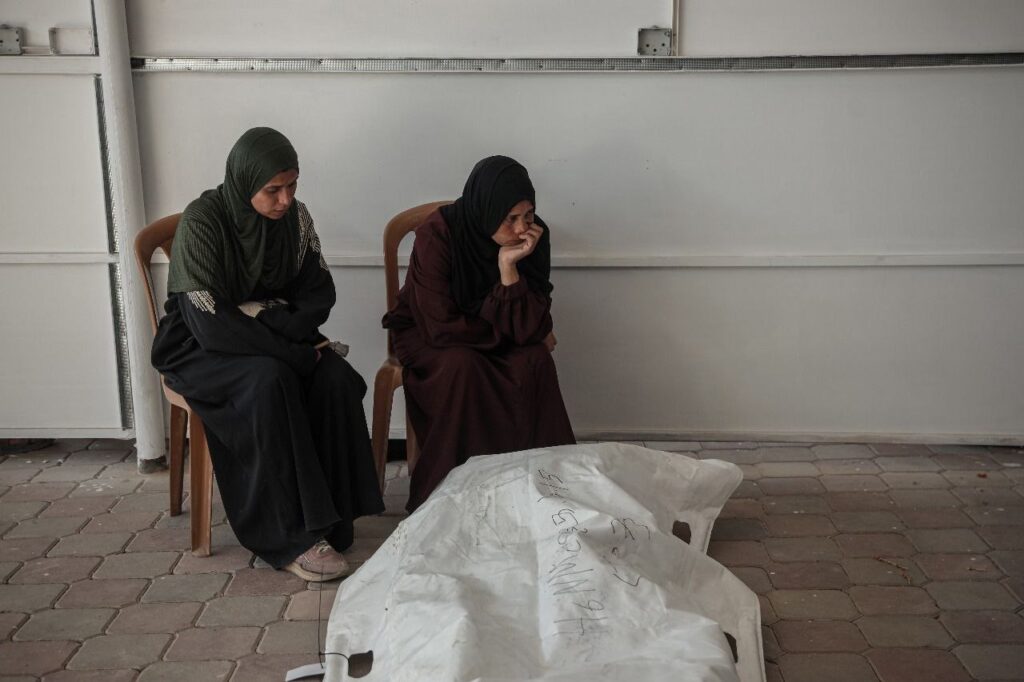

Women wait next to a body at a mortuary in Gaza. (Photo: Exclusive for Declassified)
‘Dirty actions’
Hanan accuses Israel of deliberately torturing Palestinian families twice: once by bombing them, and once by hiding the fate of their loved ones.
She says, “I am certain that sending bodies without names and erasing their features through torture is a deliberate policy aimed at exerting pressure and psychological punishment on the families of the missing.
“They also prevent the entry of DNA testing materials into Gaza, increasing our suffering.”
Abdullah’s wife believes that these practices are part of a broader Israeli policy aimed at humiliating Palestinians and depriving them even of their right to say goodbye.
“They think that with their dirty actions they will break our will. But we will not submit,” she continues.
According to a statement by Gaza’s Ministry of Health dated 8 November 2025, the number of bodies received is 300.
The statement noted that only 89 of these bodies have been identified so far.
Palestinian human rights organisations condemned the brutal behaviour of Israeli forces towards the bodies, affirming that it constitutes a violation of international law.
For Hanan, laws and statements matter less than the face of Abdullah that never leaves her memory.
She says, looking at an old photo of him on her phone: “He may be alive, or he may be a martyr, but until I know the truth, I will keep searching for him… every day, every hour.”
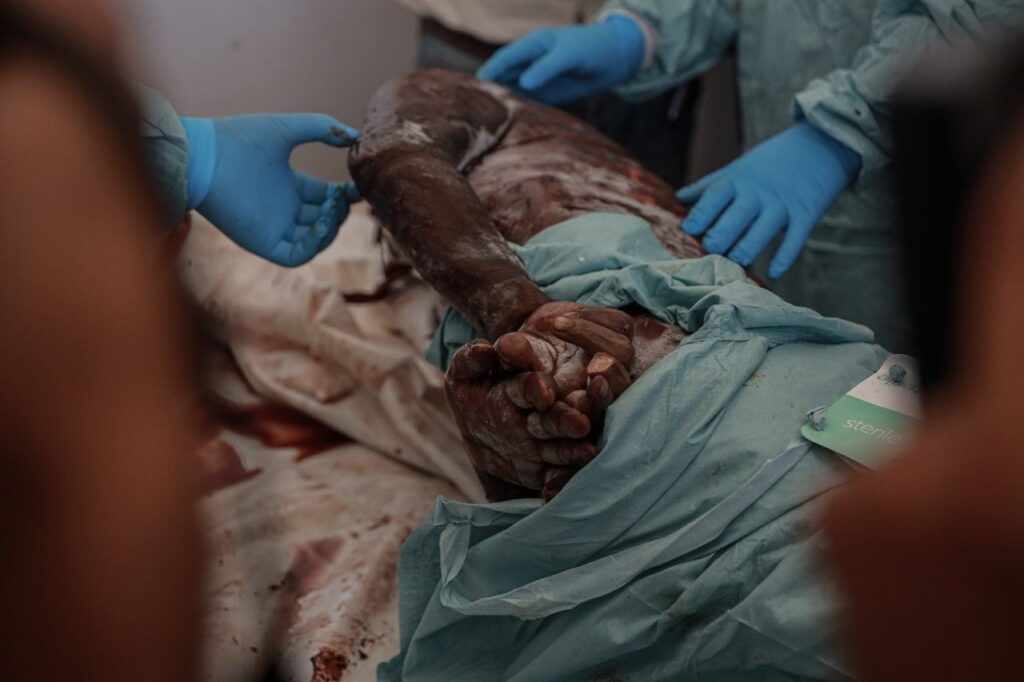
Palestinian bodies returned by Israel often bear signs of torture. (Photo: Exclusive for Declassified)
International help
Two thousand miles away in the Hague is the International Commission on Missing Persons (ICMP).
It is the world leader in identifying bodies from conflicts, tracing its origins back to the Srebrenica genocide of Bosnian Muslims in the 1990s.
Kathryne Bomberger, its director general, told Declassified: “Srebrenica is a significant part of our history. We provided evidence in 35 criminal trials in the former Yugoslavia.”
This experience could prove invaluable in the Middle East. “We are actively seeking funding to begin work in Gaza,” she explained. “Although we have not yet been able to access the area, we have already developed a clear strategy.”
This includes working with the families of the missing on both the Palestinian and Israeli sides and initiating a joint dialogue similar to their experience in the former Yugoslavia.
Bomberger believes DNA analysis will be crucial in identifying the victims, explaining that families living outside Gaza will be able to provide biological reference samples to support the matching process.
“Through our work in Syria, Iraq, and Libya, we already have a case management system in Arabic through which people can upload details about the missing,” she added.
Bomberger also pointed out that the Commission could potentially help trace children in Gaza who do not know the whereabouts of their parents through DNA analysis.
Historically, Britain’s Foreign Office has been a major funder of the Commission’s work, donating millions of pounds to the organisation.
Declassified asked the Foreign Office if it would support efforts to identify missing people in Gaza, however it did not give a definitive answer.
A Foreign Office spokesperson stated: “The ceasefire provides a moment of hope and an opportunity to alleviate the severe suffering in Gaza, to identify the missing and return them to their families, and to work towards achieving lasting peace.
“The United Kingdom has long supported the International Commission on Missing Persons (ICMP) and its work. This organisation makes significant contributions to helping countries fulfil their obligations related to accounting for the missing worldwide.”