‘Why was she shot?’ Iraqi family’s quest for justice after UK raid
One August night, Riyaadh Kadhim Alateya and his family’s lives changed forever.
The 54-year-old lived in the southern Iraqi city of Basra with his wife, Sabeeha Rasheed Mashi and his teenage son, Ali.
He ran a livestock trading business, and when he wasn’t working, his preferred way to unwind was being out on his fishing boat. They had a comfortable life.
Then it all changed suddenly. On the evening of 11 August 2007, Riyaadh said British military aircraft opened fire on the family’s home, amid accompanying gunfire.
Ali, 17, was killed and Sabeeha was left in critical condition after sustaining a gunshot wound that caused severe internal bleeding and required urgent medical intervention.
Riyaadh told Declassified that he couldn’t understand why the attack happened. But the consequences were catastrophic. “My house was completely burned down along with my belongings,” he said.
Riyaadh’s testimony is corroborated by a consistent body of contemporaneous evidence, including medical reports, court documents, legal correspondence, a death certificate, and a formal complaint lodged with and acknowledged by Iraqi police and judicial authorities in 2007, all of which were seen by Declassified.
He also shared a letter sent from the British government’s Iraq Historic Allegations Team (IHAT) in June 2015.
The unit was set up to investigate allegations of abuse, torture and unlawful killing of Iraqi civilians by British armed forces between 2003 and 2009.
In the letter, IHAT’s leader Mark Warwick expressed condolences for Ali’s death and promised to complete an investigation into what had happened in 2007, and acknowledged an involvement of British armed forces which was sufficient enough to trigger investigations.
He noted it might take time for his team to get to Riyaadh’s complaint given the sheer number that had been filed.
But Warwick assured Riyaadh that the unit “takes all allegations of misconduct and treatment very seriously”.
Nearly 20 years later, Riyaadh said he is still waiting for answers.
“Believe me, on that day, I wish I died rather than witness what happened to my family,” he said.
Unresolved crimes
Riyaadh’s testimony adds to the extensive archive of the human cost of the illegal US-led invasion of Iraq in 2003.
Tony Blair, then UK prime minister who made the decision to back the invasion, has since justified it, and faced zero accountability.
He’s now joined US president Donald Trump’s controversial “Board of Peace” which is set to govern the future of Gaza, ostensibly free to persist with his ethically fraught legacy in the region.
The British military, which has still not fully withdrawn from Iraq, developed a reputation for committing atrocities that were often left uninvestigated and unprosecuted.
The practice of shooting unarmed civilians was rife, to the degree that it constituted legitimate rules of engagement, as testimonies of former soldiers have revealed.
In Basra, British forces faced an armed uprising against their occupation in August 2007, with four soldiers killed in the week before the attack on Riyaadh’s home.
However, Declassified was shown evidence indicating that he was not involved in any military activity, nor affiliated with any armed group that might have been used to justify the targeting of him or his family.
The evidence includes a certificate from 2007 confirming his completion of a statistics course at a centre run by coalition forces in Dhi Qar governorate.
Still, that palpably offered no protection or legitimacy for his family.
“I do not know what pretext or justification there could be for opening fire on a residential home,” Riyaadh said.
IHAT, which had previously informed Riyaadh it would pursue accountability and justice, was shut down in June 2017.
None of IHAT’s investigations resulted in prosecutions in connection with unlawful killing or the ill-treatment of detainees.
IHAT did refer one case of unlawful killing and one case of ill-treatment to the Director of Service Prosecutions who in both cases decided not to proceed.
For Riyaadh, this sounds familiar. His son Ali’s case was among a group of cases taken up by Public Interest Lawyers (PIL), a UK-based law firm that brought thousands of claims to IHAT.
In a follow-up letter dated November 2015, PIL explained to Riyaadh that the cases had been considered by UK authorities and referred to the High Court.
However, the firm told Riyaadh, they were ultimately rejected, following a decision by the then UK defence secretary, on the basis that the cases were historic or further investigation was not necessary.
Lingering harm
Two decades later, Riyaadh and Sabeeha still suffer from the impact of that night.
Sabeeha sustained life-changing injuries including spinal degeneration and liver damage during the attack which have left her with chronic pain and restricted mobility.
Despite this, it took until 2017 for Iraq’s Ministry of Health to formally certify that she has a permanent disability.
After their home was destroyed, they relocated to another home in Al Tannouma in east Basra. Riyaadh devoted his time to following up on his wife’s medical condition and pursuing all avenues of treatment.
But he said the prevailing chaos and instability after the invasion meant the specialist treatment and urgent medical care required was unavailable.
In 2019, they moved to Beirut through a United Nations asylum programme and Sabeeha underwent surgery for her liver.
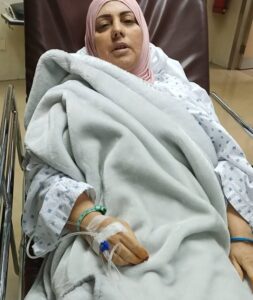

Sabeeha Rasheed Mashi undergoing treatment in Lebanon (Supplied)
Still, she is in need of continuous treatment which Riyaadh said has been tough to secure. Seeing her reduced to a painful state has been an agonising ordeal.
“What is her fault? Why is this her fate? We are a family that loves peace, we hold no hatred or resentment towards anyone,” he said.
“My wife, she is the rock of my life, the pillar of my family. Now look – more than 20 years of suffering, and for what? What is her crime? Why was she shot?”
He concluded long ago that the pursuit of justice was futile, but there are no other options.
“Peace and tolerance must prevail. The rule of law protecting civilians and human rights must be applied equally,” he said.
“Too many people with no responsibility for conflicts and wars have paid a fatal price, and greater efforts are needed to assist those affected.”
The Ministry of Defence was asked to comment.